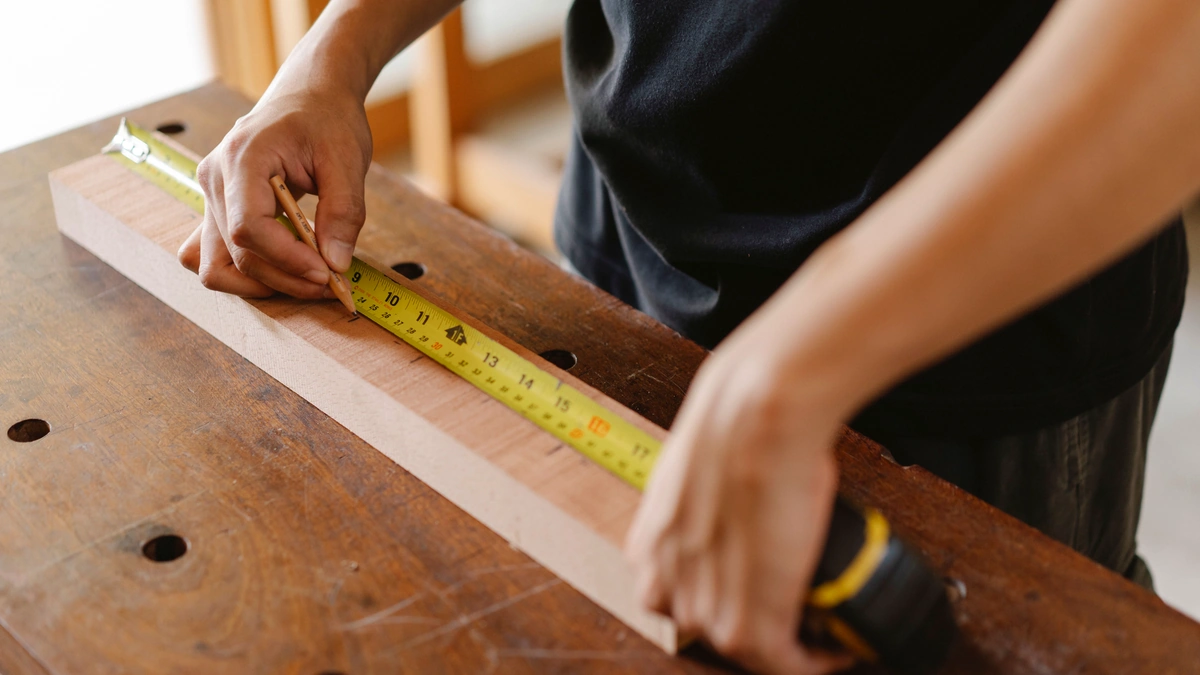
Pick up a 2×4 at any lumberyard, put a tape on it, and you get 1-1/2 by 3-1/2 inches. Nothing is wrong with the board. The gap between nominal vs actual lumber sizes is built into how lumber is named and sold, and once you know the pattern, you can plan a shelf, a deck or a wall without coming up short.
Below you will find where the numbers come from, a full size chart, how hardwood is different, and a few worked examples where the missing half inch really shows up.
What “nominal” means on a lumber tag
A nominal size is a name, not a measurement. The American Softwood Lumber Standard (PS 20-25), published through the National Institute of Standards and Technology, defines nominal size as the label designation for a lumber size category that does not reflect the dressed size. Its own example is the one everybody runs into first: a dry 2 by 4 is surfaced to 1-1/2 by 3-1/2 inches.
So when a store sells you a 2×6 or a 1×8, the label tells you which standard size you are buying. The real thickness and width come from a table in the standard, and they are always smaller than the name.
Why a 2×4 is 1-1/2 by 3-1/2 inches
The short version: logs are sawn a little oversize, then the boards are dried and planed smooth. Drying makes wood shrink, and planing (also called dressing or surfacing) takes a thin layer off every face so the pieces come out straight, smooth and uniform. What you buy is the board after both steps.
The standard sets a minimum dressed size for each nominal size. For boards and dimension lumber, “dry” means a moisture content of 19 percent or less. Some mills surface lumber while it is still green, so the standard also lists slightly bigger green sizes. A green 2×4 is 1-9/16 by 3-9/16 inches, and according to the USDA Forest Service Wood Handbook, it shrinks to about the dry size as it dries to roughly 15 percent moisture.
Length is the exception. Lumber length is recorded in actual feet, not nominal ones. Under PS 20, lumber 2 inches or less in nominal thickness is trimmed to at least its stated length and no more than 3 inches over it, so an 8-foot 2×4 should be at least a full 8 feet long.
Nominal vs actual lumber sizes chart
These are the minimum dressed dry sizes for common softwood lumber, taken from PS 20 and reproduced in Table 6-6 of the USDA Forest Products Laboratory Wood Handbook, Chapter 6. Metric values are rounded to the nearest millimeter.
| Nominal size | Actual size (inches) | Actual size (mm) |
|---|---|---|
| 1×2 | 3/4 x 1-1/2 | 19 x 38 |
| 1×4 | 3/4 x 3-1/2 | 19 x 89 |
| 1×6 | 3/4 x 5-1/2 | 19 x 140 |
| 1×8 | 3/4 x 7-1/4 | 19 x 184 |
| 1×10 | 3/4 x 9-1/4 | 19 x 235 |
| 1×12 | 3/4 x 11-1/4 | 19 x 286 |
| 2×2 | 1-1/2 x 1-1/2 | 38 x 38 |
| 2×3 | 1-1/2 x 2-1/2 | 38 x 64 |
| 2×4 | 1-1/2 x 3-1/2 | 38 x 89 |
| 2×6 | 1-1/2 x 5-1/2 | 38 x 140 |
| 2×8 | 1-1/2 x 7-1/4 | 38 x 184 |
| 2×10 | 1-1/2 x 9-1/4 | 38 x 235 |
| 2×12 | 1-1/2 x 11-1/4 | 38 x 286 |
| 4×4 | 3-1/2 x 3-1/2 | 89 x 89 |
| 4×6 | 3-1/2 x 5-1/2 | 89 x 140 |
| 6×6 | 5-1/2 x 5-1/2 | 140 x 140 |
Timbers, which start at 5 inches nominal, follow their own rule in the handbook table. A 6×6 loses 1/2 inch each way, dry or green, which is why it lands at 5-1/2 by 5-1/2. Larger timbers from 7 to 15 inches lose 3/4 inch each way when dry.
The quick rule for softwood
You do not need to memorize the chart. For the sizes most people buy, three rules cover it:
- 1-inch boards are 3/4 inch thick.
- 2-inch and 4-inch lumber lose 1/2 inch in thickness, so they are 1-1/2 and 3-1/2 inches.
- Widths under 8 inches lose 1/2 inch. Widths of 8 inches and up lose 3/4 inch. That is why a 2×6 is 5-1/2 inches wide but a 2×8 is 7-1/4.
If a board in front of you measures a bit more than the chart, that is normal. The table lists minimums, and green or freshly milled wood can run slightly fat.
Hardwood is sized differently
Oak, maple, walnut and other hardwoods are usually not sold under names like 2×4. They are sold by rough thickness in quarters of an inch, and usually in random widths. A 4/4 board (“four quarter”) is 1 inch thick in the rough, 5/4 is 1-1/4 inches, 6/4 is 1-1/2 and 8/4 is 2 inches.
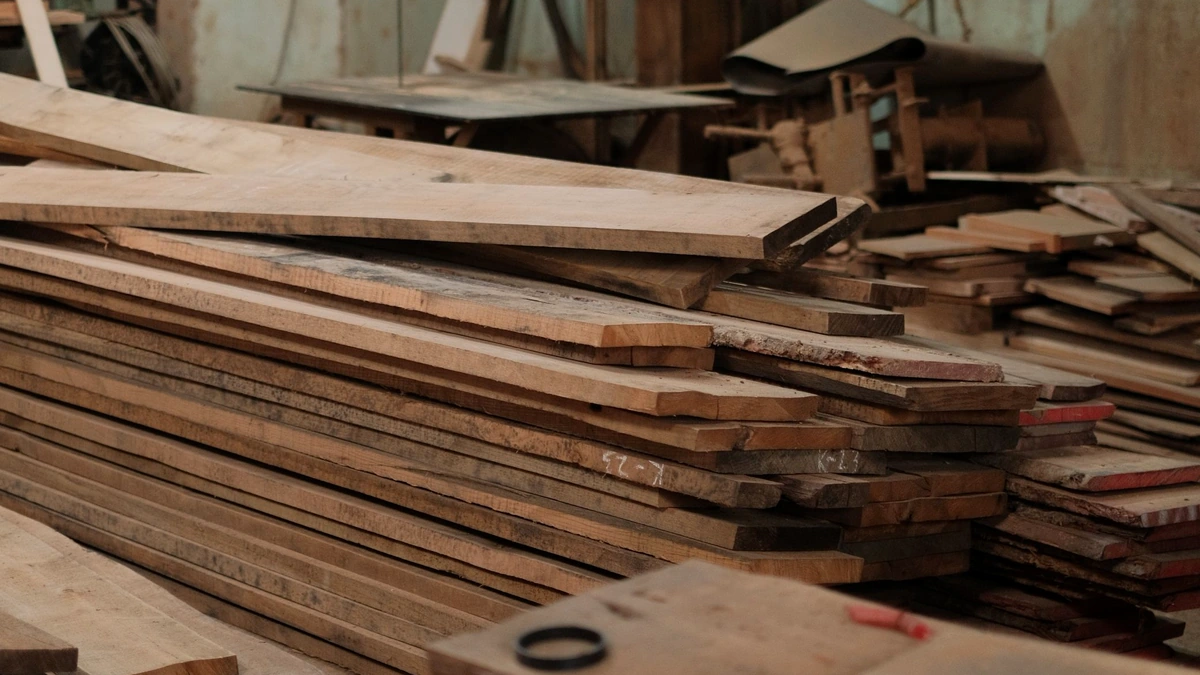
Rough boards still have to be surfaced before you build with them, and that costs thickness. The Wood Handbook lists standard surfaced (S2S, meaning planed on both faces) thicknesses for hardwood:
- 4/4 rough (1 inch) surfaces to 13/16 inch
- 5/4 rough (1-1/4 inches) surfaces to 1-1/16 inches
- 6/4 rough (1-1/2 inches) surfaces to 1-5/16 inches
- 8/4 rough (2 inches) surfaces to 1-3/4 inches
Width is a different story. Hardwood boards are measured one by one, so a 4/4 board might be 5-3/4 inches wide and the next one 8-1/2. Standard lengths run from 4 to 16 feet in 1-foot steps.
Worked examples: where the missing inches show up
Example 1: how thick is a finished wall?
A 2×4 stud wall with 1/2-inch drywall on both sides is not 5 inches thick. It is 3-1/2 + 1/2 + 1/2 = 4-1/2 inches. Build the same wall with 2×6 studs and it comes to 5-1/2 + 1/2 + 1/2 = 6-1/2 inches. That 4-1/2 is the figure that matters when you check a door jamb or a window extension.
Example 2: a 30-inch tabletop from 1×6 boards
Say you want to glue up a tabletop about 30 inches wide. Thinking in nominal sizes, 30 / 6 = 5 boards. In reality, five 1×6 boards give you 5 x 5-1/2 = 27-1/2 inches, a full 2-1/2 inches short.
With actual sizes, 30 / 5.5 = 5.45, so you need 6 boards. Six boards make 6 x 5-1/2 = 33 inches, and you rip off the extra 3 inches. Jointing the edges for a tight glue line takes a little more, so the spare width helps. Also note the top will be 3/4 inch thick, not 1 inch.
Example 3: a header that sits flush with the wall
Two 2x10s nailed together are 1-1/2 + 1-1/2 = 3 inches thick, but a 2×4 wall is 3-1/2 inches deep. Framers often add a 1/2-inch layer of plywood or OSB between the two boards, which brings the header to 3 + 1/2 = 3-1/2 inches, flush with both faces of the wall. The header is also 9-1/4 inches tall, not 10, which matters when you set the rough opening height.
If you are working from a plan drawn to scale, our proportion calculator converts drawing measurements to full size. Just make sure the plan uses actual lumber sizes, or your scaled numbers will be off by the same half inch.
Board feet still use nominal sizes
Here is the part that surprises people. When softwood lumber is priced by the board foot, the math uses the nominal numbers. PS 20 defines board measure as the nominal thickness in inches times the nominal width in feet times the length in feet.
Take a 2×10 that is 12 feet long:
- Board feet (nominal): 2 x 10 x 12 / 12 = 20 board feet
- Wood you actually get: 1.5 x 9.25 x 12 / 12 = 13.875 board feet
So you pay for 20 board feet and take home about 69 percent of that volume. That is simply how the trade counts softwood, and because quotes priced by the board foot use the same rule, they are still fair to compare. Hardwood is usually tallied on its rough thickness and the measured width of each board.
Our board foot calculator handles both cases and totals a whole cut list with waste. If you like to price lumber on your phone at the yard, our team also makes Board Foot Calculator Pro for Android.
Tips before you buy
Keep the nominal vs actual lumber sizes chart above open on your phone when you shop, and run through these checks:
- Design with actual sizes. Draw every part using the chart numbers, then convert back to nominal only for the shopping list.
- Measure a sample. Green, treated or freshly milled boards can be a little bigger and shrink as they dry. Measure one from the stack you are buying.
- Buy hardwood one step thicker. If you need a finished 1-inch part, 4/4 stock will not get you there, since it surfaces to 13/16. Start with 5/4.
- Leave room on length. Ends are often split or out of square. Plan to trim an inch or two off each end on the parts that show.
For other job-site math, like pipe offsets, voltage drop and refrigerant charge, see all of our construction calculators.
Frequently asked questions
Why is a 2×4 not actually 2 inches by 4 inches?
Because 2×4 is the name of a standard size, not its measurement. The board is sawn, dried and planed, and the American Softwood Lumber Standard sets the finished dry size at 1-1/2 by 3-1/2 inches.
What is the actual size of a 2×6?
1-1/2 by 5-1/2 inches when dry, or about 38 by 140 mm. A 2×8 is 1-1/2 by 7-1/4 inches.
Is lumber length nominal too?
No. Length is sold in actual feet. An 8-foot board should be at least 8 feet long, and for lumber 2 inches thick or less, the standard usually allows it to run up to 3 inches over.
How big is a 4×4 post really?
3-1/2 by 3-1/2 inches. A 6×6 is 5-1/2 by 5-1/2 inches.
Sizes in this article are the minimum dressed sizes from the American Softwood Lumber Standard and the USDA Wood Handbook. Individual boards vary with moisture and milling, so always measure the lumber you buy before you cut. For structural work such as headers and beams, follow your local building code and a qualified professional.
Related guides: how to calculate board feet, how much lumber costs, and the board foot calculator.