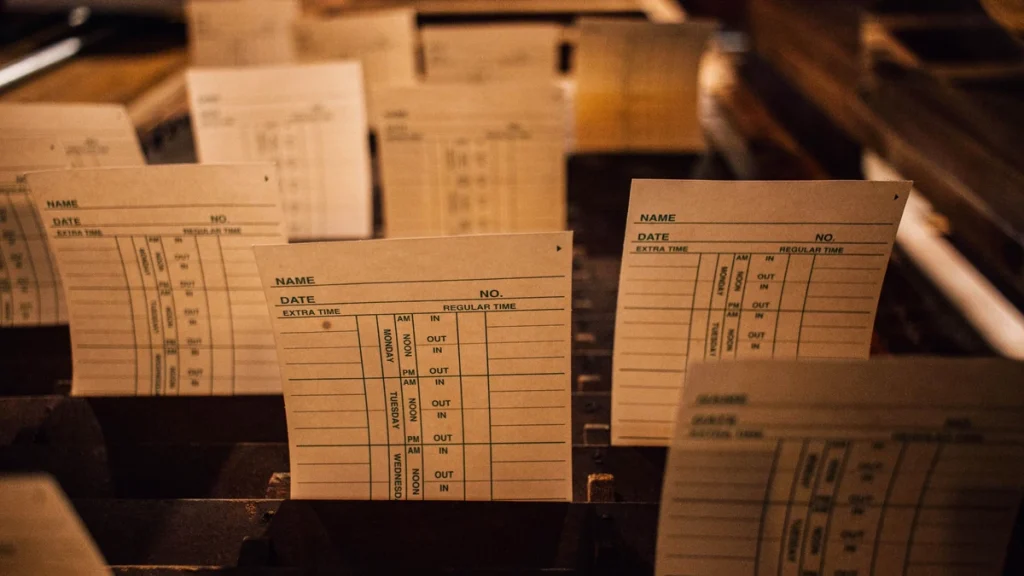
Most overtime mistakes do not happen in payroll software. They happen on the timesheet, when a 30-minute lunch gets counted the wrong way, 7 hours and 45 minutes gets written as 7.45, or a long Thursday just gets forgotten. If you know how to calculate overtime pay yourself, you can check any week in a few minutes and catch a problem before it turns into a missing line on your paycheck.
Below are the federal rules, two worked examples and the errors that come up most often. Keep last week’s timesheet nearby and follow along.
What counts as overtime under federal law
In the United States, overtime for most hourly workers comes from the Fair Labor Standards Act, usually shortened to FLSA. The U.S. Department of Labor overtime page sums up the core rule: unless you are exempt, you must be paid at least one and a half times your regular rate for every hour over 40 in a workweek.
A few details in that rule matter a lot once you sit down with a timesheet:
- It is weekly, not daily. Federal law looks at the total for the workweek. One 11-hour day does not create federal overtime by itself if the week stays at 40 hours or under.
- The workweek is fixed. It is a repeating block of 168 hours, seven 24-hour days in a row, and it can start on any day and hour. Yours might run Wednesday to Tuesday.
- No averaging. Your employer cannot balance a 30-hour week against a 50-hour week and call it even. Each week stands on its own.
- Weekends and holidays are not special on their own. Working a Saturday or a holiday does not trigger overtime unless those hours push you past 40 for the week.
- You cannot sign it away. Overtime pay cannot be waived by agreement, and a policy that overtime must be approved in advance does not cancel your right to be paid for overtime you actually worked.
All of these points come from the DOL’s Fact Sheet #23 on FLSA overtime pay. Some states add their own rules on top, such as daily overtime, so check your state labor department’s site too.
Step 1: Turn clock-in and clock-out times into hours
Start with each day on its own. Take the clock-out time, subtract the clock-in time, then take out any unpaid meal break.

Do the math in decimal hours, not clock notation. A shift from 8:15 AM to 4:45 PM is 8 hours and 30 minutes, which is 8.5 hours. To turn minutes into a decimal, divide them by 60:
- 15 minutes = 0.25 hours
- 30 minutes = 0.5 hours
- 45 minutes = 0.75 hours
- 10 minutes = about 0.17 hours
An unpaid lunch comes out of the day. A paid break stays in. Your handbook or pay stub should say which kind you get.
Step 2: Add up the full workweek
Next, add the daily totals for every day inside your workweek. Use your employer’s workweek, not the calendar. If your week starts Sunday at midnight, a Saturday night shift that runs into Sunday morning can land in two different weeks, so ask payroll how they handle that edge.
If you track this every week, our timesheet calculator takes start times, end times and breaks for all seven days and gives you the weekly total and overtime hours.
Step 3: Split regular hours from overtime hours
This part is simple. The first 40 hours are regular hours. Anything above 40 is overtime. A 46.5-hour week is 40 regular hours plus 6.5 overtime hours. A 39-hour week has no federal overtime at all, even if one of those days was 12 hours long.
Step 4: Multiply by the right rates
Your overtime rate is your regular rate times 1.5. At $20 an hour, that is $30. At $17.50, it is $26.25. Then:
- Regular hours x regular rate = regular pay
- Overtime hours x overtime rate = overtime pay
- Regular pay + overtime pay = gross pay for the week
One catch: your regular rate is not always just your base wage. The DOL says the regular rate includes all pay for employment except a short list of exclusions, such as discretionary bonuses, gifts and expense reimbursements. So a night differential, or two different pay rates in the same week, can push the rate used for overtime above your base wage.
Worked example: how to calculate overtime pay for a five-day week
Here is a realistic week for an hourly worker earning $22 an hour, with a workweek that runs Monday through Sunday. Lunches are unpaid.
- Monday: 8:00 AM to 5:30 PM, 30-minute lunch = 9.0 hours
- Tuesday: 8:00 AM to 5:00 PM, 30-minute lunch = 8.5 hours
- Wednesday: 7:45 AM to 6:15 PM, 45-minute lunch = 9.75 hours
- Thursday: 8:00 AM to 4:30 PM, 30-minute lunch = 8.0 hours
- Friday: 8:00 AM to 6:00 PM, 30-minute lunch = 9.5 hours
Weekly total: 9.0 + 8.5 + 9.75 + 8.0 + 9.5 = 44.75 hours.
Regular hours: 40. Overtime hours: 4.75.
- Regular pay: 40 x $22.00 = $880.00
- Overtime rate: $22.00 x 1.5 = $33.00
- Overtime pay: 4.75 x $33.00 = $156.75
Gross pay for the week: $880.00 + $156.75 = $1,036.75.
Notice that no single day created overtime. It was the longer Wednesday and Friday together that pushed the week past 40. Also notice how much the lunches matter. If all five had been left in by mistake, the timesheet would show 47.5 hours, and the extra 2.75 overtime hours would come to $90.75.
Night shift example: hours that cross midnight
Night shifts trip people up because the end time is a smaller number than the start time. The fix is to add 24 to the end time before you subtract. A shift from 10:00 PM to 7:00 AM becomes 31:00 minus 22:00, which is 9 hours.
Say a warehouse worker earns a base rate of $18.00 an hour plus a $1.50 night differential on every hour, and works five nights from 10:00 PM to 7:00 AM with a 30-minute unpaid meal break each night.
- Hours per night: 9 minus 0.5 = 8.5 hours
- Weekly total: 8.5 x 5 = 42.5 hours
- Regular rate: $18.00 + $1.50 = $19.50
- Regular pay: 40 x $19.50 = $780.00
- Overtime rate: $19.50 x 1.5 = $29.25
- Overtime pay: 2.5 x $29.25 = $73.13 (rounded)
Gross pay: $780.00 + $73.13 = $853.13.
If the differential had been left out of the overtime rate, the overtime would have been figured at $27.00 an hour and come to $67.50, about $5.63 short. Also, night work does not create overtime on its own under federal law. Night hours count toward the 40 like any other hours.
Common timesheet mistakes that hide overtime
- Writing minutes as decimals. 7 hours 45 minutes is 7.75 hours, not 7.45. Repeat that over a week and you can lose more than an hour.
- Mixing up paid and unpaid breaks. Only unpaid meal time comes out. Taking out paid breaks shrinks your total.
- Averaging two weeks on a biweekly check. A 36-hour week followed by a 44-hour week is 80 hours, but it still includes 4 overtime hours in week two. Each week has to be checked on its own.
- Assuming a salary means no overtime. Being paid a salary does not by itself make someone exempt. The DOL fact sheet even shows overtime math for a salaried worker.
- Forgetting off-the-clock work. Emails after clocking out or setup before clocking in are easy to miss. If your employer required or allowed it, write it down.
Check the overtime on your pay stub
Once you have your own numbers, hold them up against your pay stub line by line. Most stubs list regular hours, overtime hours and the rate for each.

- Do the regular and overtime hours on the stub match your weekly totals?
- Is the overtime rate at least 1.5 times your regular rate, including any differential?
- On a biweekly stub, can you see overtime week by week? If not, ask payroll.
- Did it arrive on time? The DOL says overtime is normally paid on the regular payday for the period it was earned in.
Logging hours on your phone during the week beats rebuilding them from memory on Friday. Our team’s app, Timesheet: Work Hours Tracker on Google Play, does that, with breaks and overtime worked out for you.
From overtime gross pay to take-home pay
Gross pay is only half the story. Overtime is still wages, so Social Security, Medicare and income tax withholding apply to it like any other pay. A big overtime week can look more heavily withheld, because withholding is estimated as if you earned that much every period.
To see what will actually land in your account, put the gross from your week into our paycheck calculator. If you work in Texas, which has no state income tax on wages, the Texas paycheck calculator skips the state step for you.
Frequently asked questions
Is overtime calculated daily or weekly?
Under federal law, weekly. Overtime is owed for hours over 40 in a workweek. Some states also have daily overtime rules, so a long day can matter depending on where you work.
Does working on a holiday or Sunday count as overtime?
Not by itself. The FLSA does not require overtime pay just because the work fell on a weekend, a holiday or a regular day off. Those hours only become overtime if they take your week past 40.
Can my employer refuse to pay overtime I did not get approved?
Your employer can set approval rules, but according to the DOL, a rule that unapproved overtime will not be paid does not remove your right to be paid for overtime hours you actually worked.
What is time and a half for $15 an hour?
$15.00 x 1.5 = $22.50 an hour. Ten overtime hours at that rate comes to $225.00.
This article is general information based on the federal FLSA rules published by the U.S. Department of Labor. It is not legal advice. State laws, union contracts and exempt status can change the answer, so for a specific dispute, contact your employer’s payroll team, your state labor department or the DOL Wage and Hour Division.
Related guides: how to calculate time and a half, the timesheet calculator, and how to figure out your take-home pay.