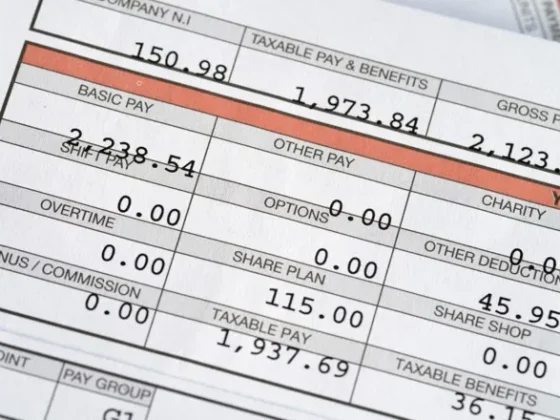
Your first Florida paycheck can surprise you in a good way. The same job that paid $1,616.73 every two weeks in California pays $1,690.85 in Florida, and nothing about the job changed. The reason is simple: Florida does not tax your wages, so the state tax line is missing from your pay stub entirely. A florida paycheck calculator still has real work to do, though, because federal withholding, Social Security, and Medicare all come out first. Here is how a Florida paycheck is actually calculated in 2026, in the order payroll does it, with a full worked example.
Try it: Florida paycheck calculator
What comes out of a Florida paycheck
Every Florida paycheck walks the same path:
- Gross pay. Everything you earned before deductions.
- Federal income tax withholding. Estimated with the IRS tables in Publication 15-T.
- Social Security and Medicare (FICA). 6.2% and 1.45% of your wages.
- The line that is not there. No Florida income tax, and no state disability deduction either. This is the step other states have and Florida skips.
- Your own deductions. 401(k), health premiums, and anything else you signed up for.
Whatever survives all five steps is your net pay. Steps 2 and 3 work the same in every state. Step 4 is where Florida separates itself, so it gets the most attention below. New to paycheck math in general? Our guide on how to calculate your paycheck covers the federal steps in full detail.
Step 1: Work out your gross pay
Hourly workers: rate × hours, with overtime at 1.5× for hours past 40 in a week. Florida follows the federal rule here, so there is no daily overtime like California has. Hours past 8 in a single day are still regular hours unless the week goes past 40.
Salaried workers: divide the yearly salary by your pay periods. A $52,000 salary paid biweekly is $2,000 of gross pay per check. A $60,000 salary paid biweekly is $2,307.69 per check.
For the rest of this guide, our example worker earns $25 an hour, works 40 hours a week, is single, and is paid biweekly: $2,000 gross per check.
Step 2: Federal income tax withholding
The federal step does not care that you live in Florida. The IRS uses the same Publication 15-T percentage method everywhere. Payroll annualizes your check, applies the standard deduction built into the withholding tables (an $8,600 stand-in for a single filer in 2026), runs the federal brackets, and divides the result back down per check.
For our $2,000 biweekly example, federal withholding comes to $156.15 per check. That is exactly what the same worker would pay in Texas or California, which is worth remembering when we compare the three states at the end.
Step 3: The Florida line that is missing
Florida does not tax wages or salaries. It is one of the few states with no personal income tax on earned income, and the state constitution locks that in (Florida Constitution, Article X, Section 24). So there is no “FL PIT” line on your pay stub, no state withholding form to fill out, and no state tax to settle when you file.
Florida also has no state disability insurance deduction. California takes 1.3% for SDI, and a few other states have their own versions. Florida takes nothing.
If your pay stub does show a state tax line, it is not Florida tax. Either your employer is withholding for another state (common if you live across a state line or work remotely for an out-of-state company), or something is set up wrong and HR should look at it. Do not just accept it.
Step 4: Social Security and Medicare
FICA is federal, so Florida workers pay the same rates as everyone else:
- Social Security: 6.2% of wages up to the $184,500 wage base in 2026. Once your yearly wages pass that amount, Social Security withholding stops for the rest of the year.
- Medicare: 1.45% of all wages, with no cap.
- Additional Medicare: 0.9% on wages over $200,000 for single filers ($250,000 for joint filers). Your employer withholds this automatically once you cross the threshold.
On a $2,000 check, Social Security is $124.00 and Medicare is $29.00, $153.00 together. These two lines are the same in Florida, Texas, and California.

A full worked example: $25 an hour in Miami
Let us put the whole check together, single filer, $25 an hour, 40 hours a week, paid biweekly:
Gross pay: $2,000.00
Federal income tax: −$156.15 (the same in any state)
Florida state income tax: −$0.00 (Florida does not tax wages)
Social Security: 6.2% × $2,000 = −$124.00
Medicare: 1.45% × $2,000 = −$29.00
Net pay: $1,690.85
That is $845.42 a week, $1,831.75 semimonthly, and $3,663.50 a month, or about $43,962 a year. A $60,000 salary on the same schedule nets $1,938.07 per check.
Now the comparison that makes it real. The identical job in Texas nets $1,690.85 per check, exactly the same, because Texas also has no state income tax. The identical job in California nets $1,616.73, because California takes state income tax and SDI. Florida pays $74.12 more per paycheck than California, about $1,927 a year, for doing the same work. If you want to run your own numbers, our Florida paycheck calculator does this same math, and the Texas paycheck calculator shows the other no-tax side.
The $15 minimum wage and tipped workers
Florida hit $15.00 an hour on September 30, 2026. That was the final scheduled step of the constitutional amendment voters approved in 2020, rising a dollar a year from $10 in 2021. Through September 29, 2026, the rate was $14.00, so pay stubs from early in the year show the old number. The $15 rate holds through 2027, and cost-of-living adjustments resume on January 1, 2028.
Tipped workers have their own numbers. The cash wage is $11.98 an hour, and the tip credit is $3.02 an hour. That means your employer pays $11.98 directly, your tips are expected to cover the other $3.02, and the two together must reach at least $15.00 an hour. If a slow shift leaves you short, the employer has to make up the difference. The $11.98 cash wage is not the full minimum wage, and it is the number most people get wrong.
There is no city minimum wage anywhere in Florida. State law blocks cities and counties from setting their own rates, so Miami, Orlando, Tampa, and Jacksonville all share the one statewide $15 rate. What differs between those cities is the work, not the wage: Miami runs on tourism and hospitality, Orlando on theme parks and service work, Tampa on logistics and health care, Jacksonville on the port and military bases.
At $15 an hour, 40 hours a week, biweekly, gross pay is $1,200 a check. Run that through the same steps and the take-home is $1,048.05, with $60.15 of federal withholding and $91.80 of Social Security and Medicare.
Why your pay stub may not match this math
- Pre-tax deductions. A 401(k) contribution lowers your federal taxable wages, so the federal line shrinks. On our $2,000 example, a 5% 401(k) contribution ($100) brings the take-home to $1,602.85. Social Security and Medicare do not shrink, because 401(k) money is still FICA wages.
- Dependents. Claiming one child under 17 (a $2,200 credit on Step 3 of your W-4) cuts federal withholding on this check to about $71, and the take-home rises to $1,775.46.
- Bonuses are withheld flat. A $1,000 bonus on top of the regular $2,000 check is withheld at the 22% federal supplemental rate, plus FICA, with no Florida tax on top. That check nets $2,394.35. Your final tax is still figured on the normal brackets when you file.
- Extra withholding. An amount you entered on Step 4(c) of your W-4 comes straight off the check.
- Withholding is an estimate, not your final tax. Payroll uses the IRS tables, not your finished return. If too much came out, the difference comes back as a refund. If too little came out, you owe the rest at filing time.
Common mistakes
- Thinking Florida withholds state tax. It does not. If you budget for a state tax line that never appears, you are leaving money on the table.
- Mixing up $14 and $15. The minimum wage stepped up on September 30, 2026. Stubs from before that date correctly show $14.
- Assuming Miami has a higher wage. It does not. One statewide rate, no city add-on.
- Treating the tipped cash wage as the full minimum. $11.98 is what the employer pays directly. Tips have to bring the total to $15.
- Expecting withholding to equal your final tax. Withholding is payroll’s best estimate. The real number is settled when you file.
Frequently asked questions
Does Florida have a state income tax?
No. Florida does not tax wages or salaries, and the state constitution bars it. Your pay stub has no state withholding line, and there is no Florida state return to file on your wages.
Why is my take-home pay the same as in Texas?
Because both states have no state income tax and no state disability deduction. The only lines on either check are federal withholding and FICA, which are identical everywhere, so the same salary nets the same amount in both states.
Is there a minimum wage in Miami?
There is no Miami-specific minimum wage. Florida law blocks cities from setting their own rates, so Miami uses the statewide $15.00 an hour, the same as Orlando, Tampa, and Jacksonville.
What counts toward the $15 an hour for tipped workers?
Your cash wage of $11.98 an hour plus your tips. The two together must reach at least $15.00 an hour, and if tips fall short on a shift, your employer must make up the difference.
How much tax is taken out of a bonus in Florida?
Federal supplemental withholding takes a flat 22% of the bonus, plus Social Security and Medicare, with no Florida tax on top. A $1,000 bonus on a regular $2,000 check nets $2,394.35 for the check.
This guide is for general education and uses 2026 federal and Florida figures. It is not tax advice. For your exact situation, check with your employer or a qualified tax professional.