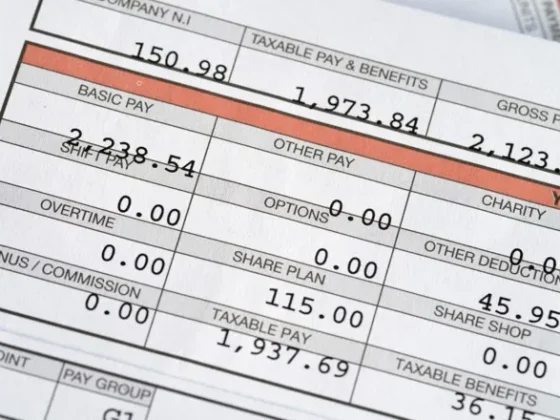
You land a job in California, the offer letter looks great, and then the first paycheck arrives noticeably smaller than your math said it should. If you moved from Texas or Nevada, two new lines on the pay stub explain most of the gap: “CA PIT” and “CA SDI.”
Try it: run your own numbers with the California Paycheck Calculator.
Neither one is a mistake. California runs its own income tax, plus a mandatory disability deduction most states do not have. This California Paycheck Calculator guide shows how a California paycheck is actually calculated in 2026, in the order payroll does it, with a full worked example.
What comes out of a California paycheck
Every California paycheck walks the same path:
- Gross pay. Everything you earned before deductions.
- Federal income tax withholding. Estimated with the IRS tables in Publication 15-T.
- Social Security and Medicare (FICA). 6.2% and 1.45% of your wages.
- California income tax. The “CA PIT” line: the state’s own tax, 1% to 12.3%.
- California SDI. The “CA SDI” line: 1.3% of all wages in 2026, with no cap.
- Your own deductions. 401(k), health premiums, and anything else you signed up for.
Whatever survives all six steps is your net pay. Steps 2 and 3 work the same in every state. Steps 4 and 5 are where California separates itself, so those get the most attention below. New to paycheck math in general? Our guide on how to calculate your paycheck covers the federal steps in full detail.

Step 1: Work out your gross pay
Hourly workers: rate × hours, with overtime at 1.5×. California also has a daily overtime rule (hours past 8 in a single day pay overtime rates, not just hours past 40 in a week), which is stricter than federal law and catches many newcomers by surprise.
Salaried workers: divide the yearly salary by your pay periods. A $52,000 salary paid biweekly is $2,000 of gross pay per check.
For the rest of this guide, our example worker earns $25 an hour, works 40 hours a week, is single, and is paid biweekly: $2,000 gross per check.
Step 2: Federal income tax withholding
The federal step does not care that you live in California: the IRS uses the same Publication 15-T percentage method everywhere. Payroll annualizes your check, applies the standard deduction built into the withholding tables, runs the federal brackets, and divides the result back down per check.
For our $2,000 biweekly example, federal withholding comes to $156.15 per check. That is exactly what the same worker would pay in Texas, which is worth remembering when we compare the two states at the end.
Step 3: California income tax (the CA PIT line)
California taxes wages in nine brackets. For 2026, a single filer’s rates from the Franchise Tax Board look like this:
| Rate | Taxable income (single) |
|---|---|
| 1% | up to $11,456 |
| 2% | $11,457 – $27,157 |
| 4% | $27,158 – $42,861 |
| 6% | $42,862 – $59,498 |
| 8% | $59,499 – $75,197 |
| 9.3% | $75,198 – $384,109 |
| 10.3% | $384,110 – $460,927 |
| 11.3% | $460,928 – $768,213 |
| 12.3% | over $768,213 |
Two things matter here. First, the brackets are marginal: only the income inside each band is taxed at that band’s rate, so a raise never makes your whole check taxed at 9.3%. Second, California’s standard deduction is small, $5,900 for single filers in 2026 ($11,800 joint), so more of your pay is taxable at the state level than at the federal level.
California also has its own withholding form, the DE 4. If you never filled one out, your employer withholds using defaults, which may not match your situation. It is worth five minutes with HR if your CA PIT line looks off.
Step 4: CA SDI, the 1.3% almost nobody explains
SDI stands for State Disability Insurance. It funds California’s disability and Paid Family Leave benefits, and in 2026 it takes 1.3% of all your wages, with no wage cap, and the employee pays all of it.
On a $2,000 check, SDI is a flat $26.00, every check, all year. Unlike the income tax, it does not shrink with brackets or allowances. There is no opting out for most employees, and it is the line item that surprises transplants the most, because only a handful of states have anything like it.

A full worked example: $25 an hour in California
Let us put the whole check together: single filer, $25 an hour, 40 hours a week, paid biweekly:
Gross pay: $2,000.00
Federal income tax: −$156.15 (the same in any state)
California income tax: Annual gross is $52,000. Subtract the $5,900 standard deduction → $46,100 of taxable income.
- 1% of $11,456 = $114.56
- 2% of $15,701 = $314.02
- 4% of $15,704 = $628.16
- 6% of $3,239 = $194.34
- Total: $1,251.08 a year → −$48.12 per check
CA SDI: 1.3% × $2,000 = −$26.00
Social Security: 6.2% × $2,000 = −$124.00
Medicare: 1.45% × $2,000 = −$29.00
Net pay: $1,616.73
Now the comparison that makes it real. The identical job in Texas, with no state income tax and no SDI, nets $1,690.85 per check. California’s two state deductions cost $74.12 per paycheck, about $1,927 a year. If you want to run your own numbers for the no-state-tax side, our Texas paycheck calculator does the same math with zero state deductions.
Why your pay stub may not match this math
Payroll uses EDD tables, not the final brackets, and your DE 4 settings move the CA PIT line directly. For the full breakdown, see how California paycheck taxes work.
Bonuses are withheld flat: 10.23% on bonuses and stock payouts, 6.6% on overtime and commission pay. For the detail, see how California paycheck taxes work.
Pre-tax deductions. A 401(k) contribution lowers both your federal and California taxable wages, so the tax lines shrink. The SDI line does not: SDI applies to your wages before that deduction.
Common mistakes
- Budgeting from the offer letter. In California, gross and net are far apart. Run the numbers before you sign a lease.
- Ignoring the DE 4. The federal W-4 does not control California withholding. Fill out both forms when you start a job.
- Treating SDI as a tax you can claim back. SDI is an insurance premium, not a tax payment, so it does not come back at filing time.
- Assuming a city tax exists. No California city taxes wages (unlike New York City), so moving from San Francisco to San Diego does not change your paycheck tax, only your rent.
Frequently asked questions
What is CA SDI on my pay stub?
State Disability Insurance: a mandatory 1.3% deduction on all wages that funds California’s disability and Paid Family Leave benefits. For the full breakdown, see how California paycheck taxes work.
What is CA PIT on my pay stub?
California Personal Income Tax: the state’s income tax withholding, computed on the nine brackets above. For the full breakdown, see how California paycheck taxes work.
How much tax is taken out of a bonus in California?
For withholding, California takes a flat 10.23% on bonuses and equity payouts, on top of 22% federal supplemental withholding and FICA. Your final tax is figured on the normal brackets when you file.
Does California tax overtime differently?
The tax treatment is the same: overtime is regular wages for tax purposes. What differs is the pay rule: California requires overtime rates after 8 hours in a day, not just after 40 in a week, so California overtime pay is often higher to begin with.
How accurate is this estimate?
Within a few dollars for most single-job workers. The main gaps come from EDD withholding tables, DE 4 settings, and deductions not shown here.
This guide is for general education and uses 2026 federal and California figures. It is not tax advice. For your exact situation, check with your employer or a qualified tax professional.