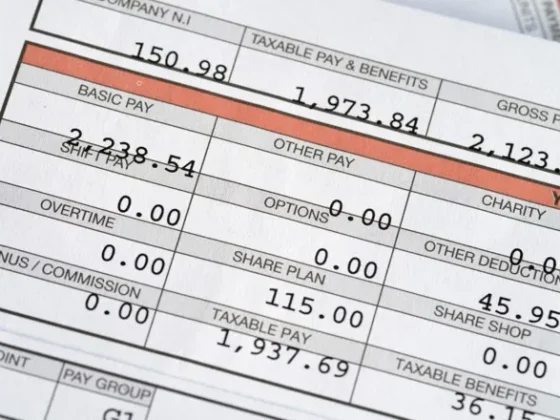
Two people earn the same $52,000 salary. One works in Austin, the other in Los Angeles. Their gross pay is identical, their federal tax is identical, and yet the Californian takes home about $74 less every single paycheck. Over a year, that gap grows to roughly $1,927.
Try it: run your own numbers with the California Paycheck Calculator.
That difference is California’s tax layer, and it confuses almost everyone who moves to the state or starts a first job there. Your stub shows lines like “CA PIT” and “CA SDI” next to the federal ones, the percentages never seem to match the bracket tables you find online, and nobody at work can quite explain why.
This guide explains California paycheck taxes: what California takes from your paycheck, how the brackets actually work, and why the numbers on your stub are a withholding estimate rather than the final bill. If you want the full step-by-step math for one paycheck, our guide on how to calculate your California paycheck walks through a complete example. Here, we stay on the tax system itself.
The short version
A California paycheck carries up to four layers of tax:
- Federal income tax, withheld from your W-4. Same in every state.
- FICA: Social Security at 6.2% (on wages up to $184,500 in 2026) plus Medicare at 1.45%. Also the same everywhere.
- California income tax, called CA PIT on your stub. Nine progressive brackets from 1% to 12.3%, withheld using the state’s own form, the DE 4.
- California SDI, a flat 1.3% of all wages with no cap. It funds disability and Paid Family Leave benefits.
Layers 1 and 2 are federal and identical in Texas. Layers 3 and 4 are the whole reason a California check is smaller, so they get most of this page.
California’s 9 income tax brackets
California does not tax income at one flat rate. It uses nine progressive brackets, which means your income is sliced into pieces and each piece is taxed at its own rate. Only the money inside a bracket pays that bracket’s rate.
Here are the 2026 brackets for a single filer (married filing jointly thresholds are exactly double):
| Your taxable income (single) | Tax rate |
|---|---|
| Up to $11,456 | 1% |
| $11,456 to $27,157 | 2% |
| $27,157 to $42,861 | 4% |
| $42,861 to $59,498 | 6% |
| $59,498 to $75,197 | 8% |
| $75,197 to $384,109 | 9.3% |
| $384,109 to $460,927 | 10.3% |
| $460,927 to $768,213 | 11.3% |
| Over $768,213 | 12.3% |
Above $1 million of taxable income, an extra 1% Behavioral Health Services tax applies, which takes the true top rate to 13.3%, the highest state income tax rate in the country.
Two things people get wrong about this table:
- Your top bracket is not your tax rate. Someone earning $60,000 does not pay 8% of everything. Most of their income is taxed at 1%, 2%, 4%, and 6% on the way up, and only the small slice above $59,498 pays 8%. The blended result, called your effective rate, is far lower than the headline bracket.
- The brackets move every year. California indexes them to inflation (about 3.4% for 2026), so last year’s table is already out of date. Using 2025 brackets is one of the most common reasons a home calculation misses.
Before the brackets even apply, California subtracts a standard deduction: $5,900 for single filers in 2026 and $11,800 for married filing jointly. It is much smaller than the federal standard deduction, which is why a bigger share of your pay gets taxed at the state level than most people expect.
Withholding: the DE 4 and the “CA PIT” line
The tax on your stub is not the final tax. It is withholding: your employer’s estimate, sent to the state each payday so you do not owe everything at filing time.
California runs its own withholding system, separate from the federal one:
- You file a Form DE 4 with your employer (California’s version of the W-4) to set your state allowances.
- Your stub shows the result as CA PIT, short for California Personal Income Tax.
- Your employer calculates it from EDD withholding schedules, not directly from the bracket table above.
That last point explains the most common California paycheck puzzle: why your stub never matches the brackets exactly. The EDD publishes its withholding schedules before the Franchise Tax Board releases the final inflation-adjusted brackets, so the 2026 schedules still run on slightly older figures (a $5,706 standard deduction instead of $5,900, for example). Small differences of a few dollars per check are normal and settle when you file your state return. It does not mean payroll made a mistake.
SDI: the flat 1.3% almost nobody can explain

The second California line on your stub, CA SDI, is State Disability Insurance. In 2026 it takes 1.3% of all your wages, and three details matter:
- There is no wage cap. The cap was removed on January 1, 2024, so SDI keeps applying long after Social Security stops. On a $200,000 salary, SDI alone is $2,600 a year.
- The employee pays all of it. Unlike some states where the cost is shared, California puts the full 1.3% on the worker.
- It is insurance, not a tax payment. SDI funds California’s disability and Paid Family Leave programs. You cannot claim it back at tax time, even if you never use the benefits.
Because SDI is a flat percentage of gross wages, it is the easiest line to verify: multiply your gross pay by 0.013 and compare it with the stub.
Bonuses, overtime, and commissions are withheld differently
Regular wages flow through the bracket schedules. Supplemental pay does not. California withholds it at flat rates:
- Bonuses and stock payouts: 10.23%
- Overtime pay and commissions: 6.6%
This is withholding only. When you file, that income is taxed through the normal brackets like everything else, and any over-withholding comes back as a refund. It is also why a bonus check looks oddly small: between the 10.23% state rate, federal supplemental withholding, FICA, and SDI, a bonus loses a much bigger slice up front than a normal paycheck does. (For how overtime itself is calculated, see our guide to time and a half.)
A few California quirks worth knowing
- Capital gains get no special rate. Unlike federal tax, California taxes capital gains as ordinary income, at the same 1% to 12.3% brackets. A big stock sale can push you through several brackets in one year.
- No city income tax. No California city taxes wages, so moving from San Francisco to San Diego changes your rent, not your paycheck tax. What does change by city is the minimum wage, which runs well above the $16.90 state floor in places like San Francisco and Los Angeles.
- Remote workers: California residents owe state tax on all income, wherever the employer sits. Nonresidents owe it only on income earned for work physically done in California. A Texas resident who flies in for a two-week project can owe California tax on those two weeks.
California vs Texas: where the $74 goes
On a $2,000 biweekly paycheck: $48.12 CA tax + $26 SDI = $74.12.
For the full check, see how to calculate your California paycheck.
Common mistakes
- Reading your top bracket as your tax rate. Progressive brackets tax slices, not the whole income. Your effective rate is always lower than your top bracket.
- Using last year’s brackets. The tables are inflation-adjusted every year. A 2025 table will quietly give you the wrong answer for 2026.
- Expecting withholding to equal the final tax. EDD schedules lag the final FTB brackets, so a few dollars of difference per check is built into the system. It settles at filing.
- Forgetting SDI has no cap. High earners often budget as if deductions stop at the Social Security wage base. SDI does not stop.
- Treating a bonus’s withholding as its tax. The flat 10.23% is an estimate. The real rate is decided by your brackets when you file.
Frequently asked questions
How much tax is deducted from a paycheck in California?
It depends on your pay and your DE 4, but a typical single filer earning $52,000 loses roughly $48 per biweekly check to CA income tax and $26 to SDI, on top of federal income tax and FICA. The state income tax piece works out to an effective rate of about 2.4% at that salary, well below the 6% top bracket it reaches.
What is CA PIT on my pay stub?
CA PIT is California Personal Income Tax: the state income tax withheld from your pay. Your employer calculates it from EDD withholding schedules using the allowances on your Form DE 4, and it is separate from federal withholding on your W-4.
What is CA SDI, and why is it 1.3%?
CA SDI is State Disability Insurance, which funds California’s disability and Paid Family Leave benefits. The rate for 2026 is 1.3% of all wages with no cap, and the employee pays the full amount. It is an insurance premium, not a tax you can reclaim at filing time.
Does California tax capital gains?
Yes, and at full income tax rates. California gives capital gains no preferential rate, so gains are taxed through the same nine brackets (1% to 12.3%) as wages. Long-term and short-term gains are treated the same.
Do remote workers pay California tax?
Residents do, on all of their income, even if the employer is in another state. Nonresidents pay California tax only on income for work physically performed in California, so workdays spent in the state can create a California tax bill even if you live elsewhere.
Why is my California withholding different from the bracket table?
Because your employer withholds using EDD schedules, and those schedules are published before the Franchise Tax Board’s final inflation adjustments. The 2026 schedules still use slightly older thresholds, so small differences are normal. Your state return reconciles the difference.
Figures reflect 2026 California and federal tax rules (FTB and EDD) and are for general education. This guide explains how the taxes work; it is not tax advice. For your exact situation, check the FTB or a tax professional.