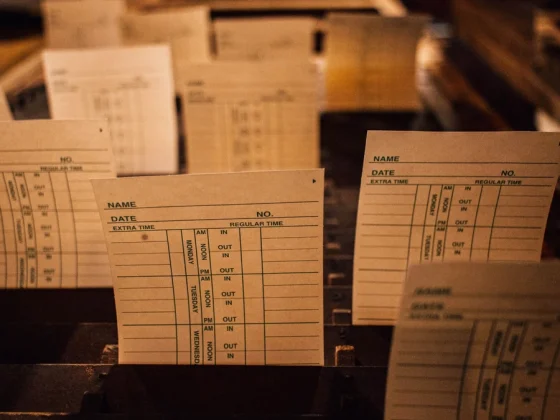
Your paycheck starts with one number: how many hours you actually worked. Get that number wrong by 15 minutes a day and a full week quietly loses more than an hour of pay. This guide walks through the same math a work hours calculator does, in the order you would use it on a timecard: work out one day first, turn the minutes into decimals, then add up the week and check for overtime. Here is how each step works, with full worked examples.
The three steps, in order
Work hours are not one subtraction. They are three steps that answer three different questions, and the order matters.
One day. How long a single shift lasted after unpaid breaks come out. This is a clock subtraction job, and it gets you the daily number.
Decimal hours. How payroll reads that number. Payroll multiplies hours by a rate, so minutes have to become a decimal first.
The week. How the days add up, and whether any of them count as overtime. Overtime is judged one workweek at a time, not one pay period.
Work out one day first, then convert it, then add the days together. The calculator has all three tools behind one weekly table, so this guide follows the same order.
Step 1: one day on the clock
For one working day, the formula is short:
Hours worked = Clock-out time – Clock-in time – Unpaid breaks
Write the times down exactly as the clock shows them. If the 12-hour clock trips you up, convert to 24-hour time first: 5:30 PM becomes 17:30, and 8:45 AM stays 08:45. Then subtract the start from the end, working from minutes up. When the minutes do not subtract cleanly, borrow an hour. For 08:45 to 17:30, the 30 minutes minus 45 does not work, so borrow an hour: 17:30 becomes 16:90, and 16:90 minus 08:45 is 8 hours 45 minutes.
Then take out the unpaid breaks, and only the unpaid ones. Which breaks are paid is not your employer’s choice alone. Under the federal rules (DOL Fact Sheet #22), short rest breaks of about 5 to 20 minutes count as work time, so you do not subtract them. A meal break of 30 minutes or more is unpaid only if you are fully relieved of duties for the whole break. If you eat at your desk while answering calls, that break is work time.
Worked example: 9:00 AM to 5:30 PM with lunch
A standard office day. Clock in at 9:00 AM, clock out at 5:30 PM, with a 30-minute unpaid lunch.
On the clock: 5:30 PM – 9:00 AM = 8 hours 30 minutes
Minus lunch: 8 hours 30 minutes – 30 minutes = 8 hours 00 minutes
Decimal: 8.0 hours
The same shape with different numbers: clock in at 8:45 AM, clock out at 5:30 PM, with a 45-minute unpaid lunch. The clock span is 8 hours 45 minutes, minus 45 minutes of lunch, which leaves exactly 8 hours 00 minutes.
Step 2: turn minutes into decimal hours
Payroll does not read hours and minutes. It multiplies a decimal number of hours by an hourly rate, so the minutes have to become a decimal first. The conversion is one division:
Decimal hours = Whole hours + (Minutes / 60)
| Minutes | Decimal hours |
|---|---|
| 5 | 0.08 |
| 10 | 0.17 |
| 15 | 0.25 |
| 20 | 0.33 |
| 30 | 0.50 |
| 40 | 0.67 |
| 45 | 0.75 |
| 50 | 0.83 |
So 7 hours 45 minutes is 7.75 hours. The most common mistake in this whole guide is writing it as 7.45 instead, reading the minutes as if they were already a decimal. At $20 an hour, 7.75 hours pays $155.00 for the day, while 7.45 hours would pay $149.00. That is $6.00 lost in one day, and $30.00 over a five-day week, for a mistake that looks like nothing on paper.
Going the other way, multiply the decimal by 60 to get minutes back. A decimal of 0.75 hours is 0.75 x 60 = 45 minutes.
Worked example: 8:15 AM to 5:30 PM with lunch
Clock in at 8:15 AM, clock out at 5:30 PM, with a 30-minute unpaid lunch.
On the clock: 5:30 PM – 8:15 AM = 9 hours 15 minutes
Minus lunch: 9 hours 15 minutes – 30 minutes = 8 hours 45 minutes
Decimal: 8 + (45 / 60) = 8.75 hours
At $20 an hour: 8.75 x $20 = $175.00 for the day
Step 3: add up the week and find overtime
Add the daily decimal totals together, day by day, before you do anything else. Then compare the weekly total with 40 hours. Under the FLSA, overtime starts after 40 hours in one workweek, paid at 1.5 times the regular rate, which is time and a half. The time and a half guide works through the rate itself, with the federal rules behind it, and the overtime pay guide shows the same weekly total on a full timesheet.
Overtime hours = Weekly hours – 40 (if positive)
Gross pay = Regular hours x Rate + Overtime hours x Rate x 1.5
Two things people get wrong here. First, overtime is judged one workweek at a time, not one pay period. A 45-hour week followed by a 35-hour week is 5 overtime hours, not zero, even though the two weeks average 40. Second, paid time off does not count toward the 40. If you worked 36 hours and took 8 hours of PTO, you have 36 hours of work, so no overtime is triggered.
That gross pay is before taxes. What actually lands in your account is the take-home pay, and the take-home pay guide walks through the deductions that come off it.
Worked example: a full week from the calculator
Take the week the Timesheet calculator loads with by default: Monday to Friday, 8:00 AM to 5:30 PM, with a 30-minute unpaid lunch each day, at $20 an hour.
One day: 5:30 PM – 8:00 AM = 9 hours 30 minutes, minus 30 minutes = 9 hours 00 minutes
Five days: 5 x 9 = 45 hours 00 minutes
Overtime: 45 – 40 = 5 hours
Regular pay: 40 x $20 = $800.00
Overtime rate: $20 x 1.5 = $30.00 an hour
Overtime pay: 5 x $30 = $150.00
Gross pay: $800 + $150 = $950.00
That matches the calculator’s own summary exactly: 45 hours, 40 regular, 5 overtime, $950 gross.

Night shifts and split shifts
When a shift crosses midnight, the clock-out time is smaller than the clock-in time, and plain subtraction gives a negative number. Add 24 hours to the clock-out time first, then subtract as usual. A night shift from 10:00 PM to 6:00 AM with a 30-minute unpaid break works out like this: 6:00 AM plus 24 hours is 30:00, minus 10:00 PM is 8 hours, minus the 30-minute break is 7 hours 30 minutes, or 7.5 hours.
A split shift is simpler: work out each stretch on its own and add the stretches together. Work 8:00 AM to noon, then 1:00 PM to 5:00 PM, and the day is 4 hours plus 4 hours, which is 8 hours. The unpaid hour in the middle is simply not counted, so do not subtract it a second time.
Rounding: the 7-minute rule
Some employers round clock times, and the federal rules allow it, as long as the rounding does not shortchange workers over time (29 CFR 785.48). Three methods are allowed: to the nearest 5 minutes, to the nearest tenth of an hour (6 minutes), or to the nearest quarter hour (15 minutes).
The quarter-hour version is called the 7-minute rule. A punch at 8:07 rounds down to 8:00, because 7 minutes is within the first half of the quarter. A punch at 8:08 rounds up to 8:15. The rounding is applied to the clock times, not to the weekly total, and it has to average out fairly over time. If every punch rounds against you, the rounding is not legal.
Common mistakes
- Reading minutes as a decimal. 7 hours 45 minutes is 7.75 hours, not 7.45.
- Subtracting paid rest breaks. Short breaks of about 5 to 20 minutes count as work time.
- Forgetting the unpaid lunch. A 30-minute lunch every day is 2.5 hours a week.
- Judging overtime by the pay period. Overtime is judged one workweek at a time.
- Forgetting the midnight add on night shifts. Add 24 hours to the clock-out time first.
- Rounding the weekly total. Rounding applies to the clock times, not to the total.
- Multiplying hours and minutes by the rate. 41 hours 15 minutes at $20 is 41.25 x $20 = $825.00, not 41.15 x $20 = $823.00.
The short version
Write down the exact clock-in and clock-out times, subtract the start from the end, take out only the unpaid breaks, divide the leftover minutes by 60, and add each day together for the week. Anything over 40 hours in that one week is overtime at 1.5 times the rate. The same three steps run the free Timesheet calculator, and the rest of the work hours tools are in the Work Hours hub.
Frequently asked questions
How do I calculate my work hours for one day?
Subtract the clock-in time from the clock-out time, then subtract any unpaid breaks. A 9:00 AM to 5:30 PM day with a 30-minute unpaid lunch is 8 hours.
How do I convert minutes to decimal hours?
Divide the minutes by 60. 45 minutes is 0.75 hours, so 7 hours 45 minutes is 7.75 hours, which is the number payroll multiplies by your rate.
Do lunch breaks count as work hours?
A meal break of 30 minutes or more is unpaid only if you are fully relieved of duties for the whole break. Short rest breaks of about 5 to 20 minutes count as work time and are not subtracted.
How do I calculate work hours for a night shift?
Add 24 hours to the clock-out time first, then subtract as usual. A 10:00 PM to 6:00 AM shift with a 30-minute unpaid break is 7 hours 30 minutes, or 7.5 hours.
When does overtime start?
After 40 hours in one workweek under the FLSA, paid at 1.5 times the regular rate. Overtime is judged per workweek, not per pay period, so a 45-hour week followed by a 35-hour week still has 5 overtime hours.
Can I use this calculator for a two-week pay period?
Yes, but add each week separately, because overtime is judged one week at a time. Two 45-hour weeks at $20 an hour come to $1,900 gross. Counting 90 hours as one block would wrongly give 50 overtime hours and $2,300.
Hours shown are estimates for general education. Overtime rules vary by state and employer, and some jobs are exempt, so check your state labor rules and your pay stub.