This proportion calculator guide shows how to solve a proportion the same way every time: set the two ratios up correctly, cross multiply, divide, and check. A proportion is just a statement that two ratios are equal, written A/B = C/D. If you know three of the four numbers, the fourth is never a guess. It is one multiplication and one division away.
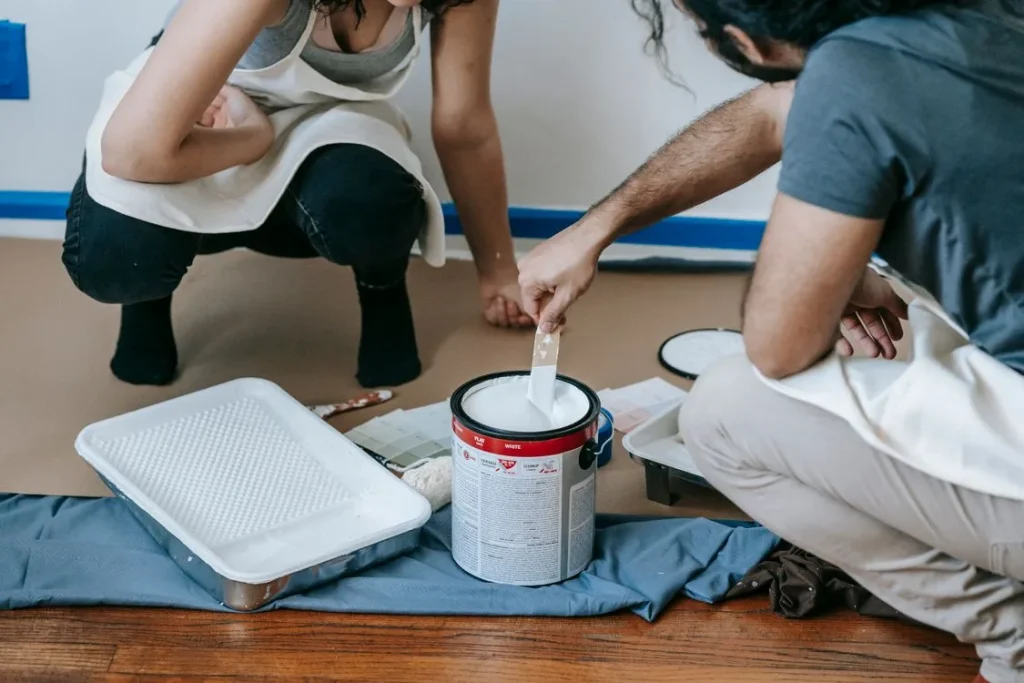
Picture a painter with a simple job. Three litres of paint cover 24 square metres of wall, and the next wall is 40 square metres. The painter does not guess, and does not buy twice as much paint just to be safe. The two ratios are 3/24 and x/40, the cross products give 120 = 24x, and x = 5 litres. That is the whole method, and it works for recipes, maps, prices, percentages, and shadows in exactly the same way.
What a proportion is, and what it is not
A ratio compares two quantities. Three cups of flour to four eggs is the ratio 3:4, written 3/4. A proportion says two ratios are equal: 3/4 = 15/20. The top numbers (A and C) must describe the same kind of quantity, and the bottom numbers (B and D) must describe the same kind of quantity. Litres over square metres on the left means litres over square metres on the right. If the kinds do not line up, the answer will be wrong even if the arithmetic is right.
The key property is that the cross products are equal: A x D = B x C. That one property turns a proportion into a simple equation. It is also the check at the end. If the two cross products do not match, the answer is wrong, and you can find the mistake before you trust the number.
The method in four steps
- Write the two ratios with the unknown as x, keeping the same kind of quantity in the same position on both sides.
- Cross multiply: multiply the two numbers diagonally across from each other to get A x D = B x C.
- Divide both sides by the number beside x. The rule of thumb is: multiply the two numbers diagonally across from the unknown, then divide by the number left over.
- Check: put the answer back in and confirm that the two ratios give the same decimal, and that the two cross products match.
The calculator on this site does the same steps and shows them. Use it to check your hand work, not to replace the understanding of why the steps work.
Worked example 1: paint for a bigger wall
Three litres cover 24 square metres. How many litres cover 40 square metres?
Set it up as 3/24 = x/40. Cross multiply: 3 x 40 = 24x, so 120 = 24x. Divide by 24: x = 5 litres.
Check: 3/24 = 0.125 and 5/40 = 0.125. The ratios match. Sanity check: 40 square metres is bigger than 24, so the answer should be bigger than 3 litres, and 5 is.
Worked example 2: a recipe for more muffins
A recipe uses 4 cups of flour for 12 muffins. How much flour for 30 muffins?
Set it up as 4/12 = x/30. Cross multiply: 4 x 30 = 12x, so 120 = 12x. Divide by 12: x = 10 cups.
Check: 4/12 = 0.333 and 10/30 = 0.333. The ratios match. Notice that the flour scales by the same factor as the muffins: 30 is 2.5 times 12, and 10 is 2.5 times 4.
Worked example 3: a map distance
On a map, 2 centimetres stand for 5 kilometres. A route measures 7.5 centimetres on the map. How far is it in real life?
Set it up as 2/5 = 7.5/x. Cross multiply: 2x = 5 x 7.5, so 2x = 37.5. Divide by 2: x = 18.75 kilometres.
Check: 2/5 = 0.4 and 7.5/18.75 = 0.4. The ratios match. This is the same method with the unknown on the bottom, which is why step 3 says to divide by the number beside x, whichever side it is on.
Worked example 4: a percentage as a proportion
A student scores 27 marks out of 60. What percent is that?
A percent is a proportion with 100 in one spot: 27/60 = x/100. Cross multiply: 27 x 100 = 60x, so 2700 = 60x. Divide by 60: x = 45 percent.
Check: 27/60 = 0.45 and 45/100 = 0.45. Any "what percent is A of B" question works this way, which makes the proportion method useful far beyond ratio homework.
Worked example 5: a height from a shadow
A 5 foot post casts a 3 foot shadow at the same time of day that a building casts a 21 foot shadow. How tall is the building?
Set it up as 5/3 = x/21. Cross multiply: 5 x 21 = 3x, so 105 = 3x. Divide by 3: x = 35 feet.
Check: 5/3 = 1.667 and 35/21 = 1.667. The ratios match. Similar triangles work this way because the sun’s angle is the same for both objects, so the height to shadow ratios are equal.
Direct proportion, and the inverse trap
Everything above is a direct proportion: when one quantity goes up, the other goes up by the same factor. Some problems are inverse: more of one means less of the other. If 6 workers finish a job in 8 hours, 12 workers do not take 16 hours. They take 4 hours, because the product stays the same: 6 x 8 = 48, and 48 / 12 = 4.
For an inverse problem, do not use A/B = C/D. Set the products equal instead. A quick sanity check before you solve saves most of these mistakes: should the answer be bigger or smaller than what you started with? If the problem says more workers, the time should be smaller, so a bigger answer is a warning sign.
Setting up a word problem without getting lost
Most proportion mistakes happen before any arithmetic, in the setup. Three habits prevent them.
- First, name the quantities before you write numbers. Write "litres" and "square metres", or "cups" and "muffins", next to each ratio. If the labels do not match on both sides, stop and fix the setup.
- Second, convert units first. Comparing 2 feet with 30 inches without converting gives a wrong answer, because the numbers are in different units even though they describe the same kind of quantity. Convert to one unit, then set up the proportion.
- Third, keep full decimals until the final answer. Rounding in the middle, especially on a map or a price, carries a small error into every later step. Round only at the end, and only to the precision the problem needs.
Common mistakes
- Swapping the order. Cups over servings on the left means cups over servings on the right. If you put servings over cups on one side, the answer will be upside down.
- Mixing units. Feet and inches, litres and millilitres, or hours and minutes must be converted to one unit first.
- Using a direct proportion for an inverse problem. Workers and hours, speed and travel time, and similar pairs need the product method, not the ratio method.
- Rounding too early. Keep the decimals through the cross multiplication and the division, then round the final answer.
- Dividing by zero. If a value you need to divide by is zero, the proportion has no answer in that form. Check the setup, because a zero usually means a quantity was placed in the wrong spot.
Related guides: check your bill-splitting math with the tip calculator, or estimate lumber costs with the board foot calculator.
FAQs
How do you solve a proportion when x is on the bottom?
Cross multiply the same way, then divide by the number beside x. For 2/3 = 10/x, cross multiplication gives 2x = 30, so x = 15. Check: 2/3 = 0.667 and 10/15 = 0.667.
How do you check a proportion answer?
Put the answer back in and compare the two ratios as decimals, and compare the two cross products. For 3/24 = 5/40, both ratios are 0.125, and both cross products are 120. If either check fails, the setup or the arithmetic is wrong.
What is the difference between a ratio and a proportion?
A ratio compares two numbers, like 3:4. A proportion is a statement that two ratios are equal, like 3:4 = 15:20. Every proportion contains two ratios, but a single ratio on its own is not a proportion.
Can a proportion find a percentage?
Yes. Put the percent over 100: part/whole = x/100. For 27 out of 60, 27/60 = x/100 gives x = 45 percent. The same method works for any part and whole.
What if the answer looks too big or too small?
Trust the sanity check and re-examine the setup. In a direct proportion, a bigger starting quantity should give a bigger answer, and a smaller one should give a smaller answer. If the answer goes the wrong way, the ratios are probably swapped, or the problem is inverse and needs the product method.