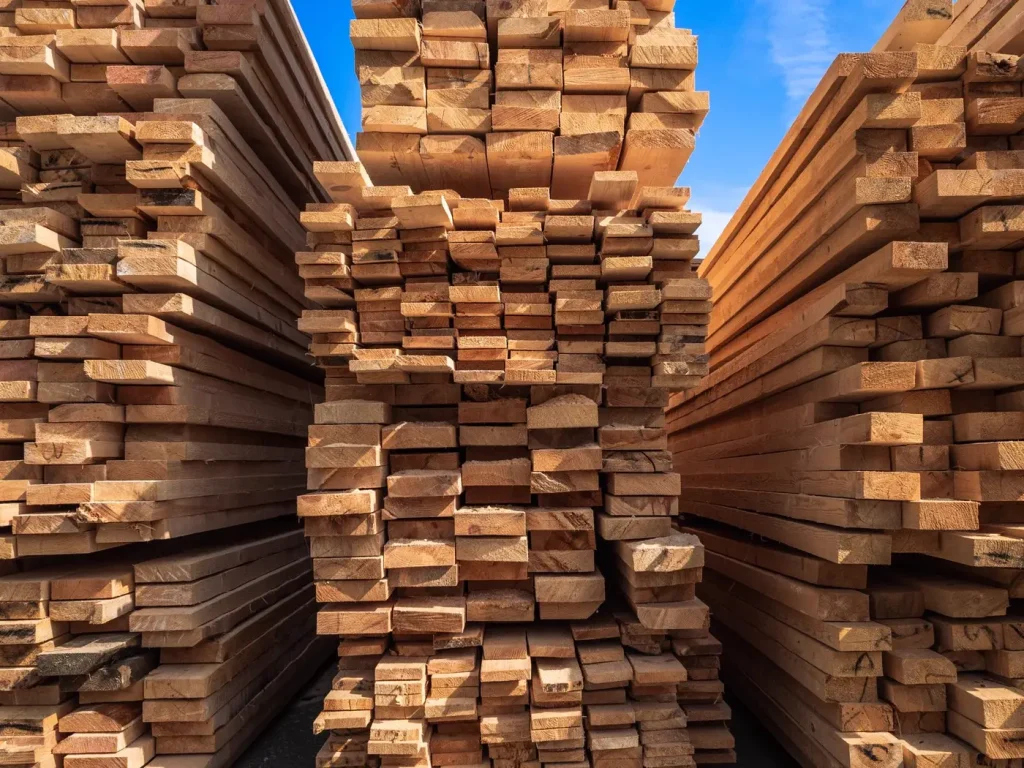
You are standing in the lumber aisle with a project list, and the price tag says $6.20 per board foot. Per board… what? The boards are labeled 2×6, the lengths are in feet, and nothing on the shelf explains how those numbers turn into the number on your receipt.
It is simpler than it looks. A board foot is just a unit of volume, and once you know how to calculate board feet with the one formula behind it, you can price any stack of lumber in your head before you reach the register.
This page teaches the formula for calculating board feet.
What is a board foot?
A board foot is 144 cubic inches of wood. Picture a board 12 inches wide, 12 inches long, and 1 inch thick. That single chunk is exactly one board foot.
Lumberyards sell most hardwood and softwood this way because boards come in so many widths and thicknesses that pricing by the piece would be chaos. The board foot gives every board a common currency: volume.
The board foot formula
Here is the whole thing:
Board feet = (thickness in inches × width in inches × length in feet) ÷ 12
That is it. Measure thickness and width in inches, length in feet, multiply the three numbers, and divide by 12.
Why 12? Because a 1-inch-thick, 12-inch-wide, 1-foot-long board works out to (1 × 12 × 1) ÷ 12 = 1 board foot. The formula just scales that reference chunk up or down.
One note for hardwood shoppers: hardwood thickness is often written in quarters, so 4/4 means 1 inch, 5/4 means 1.25 inches, and 8/4 means 2 inches. A 4/4 board goes into the formula as 1.
Step-by-step: calculating board feet
Let us work a real one. Say you are buying 2×6 boards, 10 feet long.
- Write down the three numbers. Thickness: 2 inches. Width: 6 inches. Length: 10 feet.
- Multiply them. 2 × 6 × 10 = 120.
- Divide by 12. 120 ÷ 12 = 10 board feet.
One 2×6×10 board is 10 board feet. Need six of them? That is 60 board feet total.
Try a smaller board to lock it in: a 2×4 that is 8 feet long. (2 × 4 × 8) ÷ 12 = 64 ÷ 12 = 5.33 board feet per board.
Here is a quick reference for the sizes you will grab most often:
| Board size | Board feet |
|---|---|
| 2×4×8 | 5.33 |
| 2×4×10 | 6.67 |
| 2×6×8 | 8 |
| 2×6×10 | 10 |
| 2×8×10 | 13.33 |
| 2×10×12 | 20 |
If you would rather skip the arithmetic in the aisle, our board foot calculator runs the same math instantly, which is handy when you are working through a long cut list.
Nominal vs. actual: which numbers do you use?
Here is the trap most beginners fall into. A board sold as a “2×4” does not actually measure 2 inches by 4 inches. Under the American Softwood Lumber Standard (PS 20), a nominal 2×4 is really 1.5 × 3.5 inches after drying and surfacing.
So which numbers go into the formula? Use the nominal sizes: the 2 and the 4, not the 1.5 and the 3.5. Lumberyards price and sell softwood by nominal dimensions, so the board-foot math follows the name on the tag, not the caliper reading.
This is the number-one source of confusion at the lumberyard, and we wrote a full breakdown of it: nominal vs. actual lumber sizes, with the complete PS 20 size chart.
How to calculate lumber cost from board feet
Total cost = board feet × price per board foot
Back to our 2×6×10 example: 10 board feet at $6.20 per board foot comes to 10 × $6.20 = $62.00 for the board. For the full price guide, see how much lumber costs per board foot.
How many boards do you need for a project?
Flip the formula around. Say your project needs 60 board feet and you are buying 2×4×8 boards (5.33 board feet each):
60 ÷ 5.33 = 11.25 boards
You cannot buy a quarter of a board, so round up: buy 12 boards. The extra covers miscuts, knots you want to cut around, and the piece you will inevitably measure wrong once.
Add 10–15% to whatever the math says for waste; the lumber cost guide’s waste-factor section explains why.
Common mistakes
- Using actual instead of nominal dimensions. The 2×4 is really 1.5 × 3.5, but the formula wants the nominal 2 × 4.
- Mixing up inches and feet. Thickness and width in inches, length in feet. A 10-foot board is 10 in the formula, not 120.
- Confusing board feet with linear feet. A linear foot is just 12 inches of length, so a 10-foot board is 10 linear feet no matter how wide it is. Board feet account for width and thickness too.
- Forgetting the divide-by-12 step. The most common arithmetic slip, and it makes your answer 12 times too big.
Frequently asked questions
What is a board foot of lumber?
144 cubic inches of wood, the volume of a board 12 inches wide, 12 inches long, and 1 inch thick. It is the standard unit lumberyards use to measure and price wood.
How do you calculate board feet?
Multiply thickness (inches) × width (inches) × length (feet), then divide by 12. A 2×6 board 10 feet long is (2 × 6 × 10) ÷ 12 = 10 board feet.
How many board feet are in a 2×4×8?
Using nominal dimensions: (2 × 4 × 8) ÷ 12 = 5.33 board feet.
Do I use nominal or actual measurements?
Nominal, meaning the sizes on the tag (2×4, 2×6). Actual surfaced dimensions are smaller, but the lumber trade prices by nominal size.
What is the difference between a board foot and a linear foot?
A linear foot measures length only: 12 inches, whatever the width. A board foot measures volume: thickness × width × length. A 2×6×10 is 10 linear feet and 10 board feet; a 2×12×10 is also 10 linear feet, but 20 board feet.