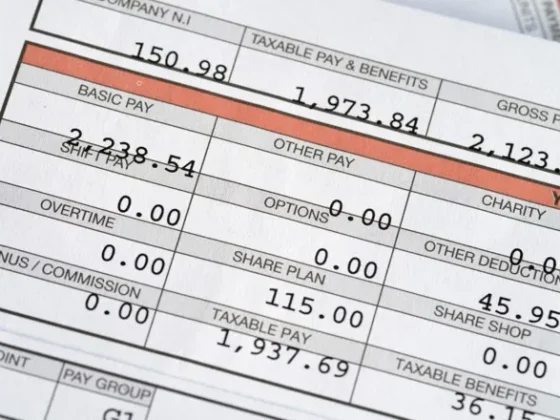
If you just moved to Texas or started your first job here, you have probably heard there is no state income tax. That part is true. Your check still comes out smaller than your gross pay, though, and it helps to know exactly where the money goes. Texas paycheck taxes are really federal taxes, plus whatever deductions you signed up for at work.
Below we go through each line, then run two 2026 examples: an hourly worker paid weekly and a salaried employee paid twice a month.
Texas paycheck taxes: what actually comes out
For most Texas employees, only three taxes come out of each check:
- Social Security: 6.2% of your wages
- Medicare: 1.45% of your wages
- Federal income tax withholding: an amount based on your pay, your pay schedule and your Form W-4
Your employer also takes out anything you signed up for, such as 401(k) contributions or health premiums. Those are not taxes, but they sit next to the taxes on a stub, so they are easy to mix up.
What you won’t see on a Texas pay stub
Texas has no personal income tax. In fact, the Texas Constitution (Article 8, Section 24-a) bars the Legislature from putting a tax on the net incomes of individuals. So there is no state withholding line at all.
A few other items are missing too:
- State unemployment tax. Employers pay it. The Texas Workforce Commission says the law does not allow employers to deduct money from your paycheck to pay for unemployment benefits.
- State disability or paid leave premiums. Some states fund these programs through payroll deductions. A typical Texas pay stub has no line for them.
If you moved here from a state with an income tax, this is where most of the difference in take-home pay comes from.
Social Security and Medicare: a flat 7.65%
These two are often grouped together as FICA. According to the Social Security Administration, for 2026 Social Security is 6.2% of wages up to $184,500, and Medicare is 1.45% of all wages with no cap. Together that is 7.65% for most people.
Your employer pays a matching amount, but that share never comes out of your check. Once your wages from one employer pass $200,000 in a year, the employer must also withhold an extra 0.9% Additional Medicare Tax on the wages above that point, as the IRS explains.
Federal income tax withholding: the line that varies
Employers figure this one with the tables in IRS Publication 15-T and your W-4. If your W-4 is basic (one job, no dependents claimed, no extra withholding), you can get the same answer at home:
- Multiply your federally taxable pay per check by the number of paychecks in a year.
- Subtract the 2026 standard deduction: $16,100 for single filers, $32,200 for married couples filing jointly or $24,150 for heads of household.
- Apply the 2026 tax brackets to what is left.
- Divide the yearly tax by the number of paychecks.
Under the 2026 IRS inflation adjustments, a single filer pays 10% on the first $12,400 of taxable income, 12% on income up to $50,400 and 22% on income up to $105,700. For married couples filing jointly, the 10% bracket runs to $24,800 and the 12% bracket to $100,800.
Brackets are marginal. Reaching the 22% bracket does not mean all of your income is taxed at 22%, only the dollars inside that bracket.
Pre-tax deductions change what gets taxed
Some workplace deductions come out before tax, but not every one lowers every tax:
- Traditional 401(k): lowers the wages used for federal income tax, but Social Security and Medicare still apply to that money.
- Health, dental and vision premiums through a cafeteria plan: usually lower both your income tax wages and your Social Security and Medicare wages.
- Roth 401(k): comes out after tax, so it does not lower any of the taxes above.
That is why a stub can show one taxable wage figure for federal income tax and a different one for Social Security.
Example 1: $18 an hour in San Antonio, paid weekly
Luis drives a forklift at a warehouse in San Antonio. He earns $18 an hour, works 40 hours a week, is paid weekly and files single. His benefits have not started yet, so he has no pre-tax deductions.

- Gross pay: 40 x $18 = $720.00
- Social Security: $720 x 6.2% = $44.64
- Medicare: $720 x 1.45% = $10.44
- Federal income tax: $720 x 52 = $37,440 a year. Minus $16,100 leaves $21,340. That is 10% of $12,400 ($1,240) plus 12% of the remaining $8,940 ($1,072.80), or $2,312.80 a year. Divided by 52, about $44.48 a week.
- Texas income tax: $0
Net pay: $720.00 minus $44.64 minus $10.44 minus $44.48 = $620.44.
About 13.8% of his gross goes to taxes, and more than half of that is Social Security and Medicare, not income tax.
What changes in an overtime week
Now say Luis works 46 hours one week. Under the federal Fair Labor Standards Act, most hourly workers earn time and a half for hours over 40 in a workweek, as the U.S. Department of Labor explains. His 6 overtime hours pay $27 each.
- Gross pay: $720 + (6 x $27) = $882.00
- Social Security: $54.68
- Medicare: $12.79
- Federal income tax: about $63.92
- Net pay: $750.61
The extra $162 of gross pay added $130.17 to his check. Withholding treats each check as if every week of the year looked like it, so a big overtime week can feel heavily taxed.
There is also a newer federal deduction for qualified overtime pay, meaning the extra “half” in time and a half. For Luis that is $9 on each of the 6 hours, or $54. Publication 15-T says eligible workers can deduct up to $12,500 a year ($25,000 if married filing jointly) for tax years 2025 through 2028. Social Security and Medicare still apply. You can claim it on your return, or give your employer an updated W-4 so less is withheld. Our guide on how to calculate overtime pay covers the math in more detail.
Example 2: $78,000 salary in Austin, paid twice a month
Priya works in an office in Austin on a $78,000 salary, paid semimonthly, so 24 checks a year. She is married filing jointly, her spouse is not working right now, and she claims no dependents on her W-4. She puts 6% into a traditional 401(k) and pays $120 per check for health insurance through her employer’s cafeteria plan.

- Gross pay: $78,000 / 24 = $3,250.00
- 401(k) at 6%: $195.00
- Health insurance: $120.00
- Social Security: ($3,250 minus $120) x 6.2% = $194.06
- Medicare: $3,130 x 1.45% = $45.39
- Federal income tax: taxable pay per check is $3,250 minus $195 minus $120 = $2,935. Times 24 is $70,440. Minus the $32,200 standard deduction leaves $38,240. That is 10% of $24,800 ($2,480) plus 12% of $13,440 ($1,612.80), or $4,092.80 a year, about $170.53 per check.
- Texas income tax: $0
Net pay: $3,250.00 minus $195.00 minus $120.00 minus $194.06 minus $45.39 minus $170.53 = $2,525.02.
Her taxes total $409.98, about 12.6% of gross. Another $315 goes to her own retirement savings and health coverage, so the deposit ends up at about 77.7% of gross pay.
High earners: the Social Security cap and extra Medicare
Two rules only show up at higher incomes. Picture a single filer earning $240,000 a year, paid biweekly, with no pre-tax deductions. Each check is about $9,230.77.
- Social Security stops at $184,500. That limit is reached partway through the 20th paycheck, so the last six checks of the year have no Social Security taken out. Full-year Social Security is $184,500 x 6.2% = $11,439.00.
- Medicare keeps going and gets bigger. 1.45% of $240,000 is $3,480.00. The 0.9% Additional Medicare Tax on the $40,000 above $200,000 adds $360.00, starting in the 22nd paycheck.
So if your December checks look larger than your spring ones, the Social Security cap is usually the reason.
Where Texans pay instead: sales and property tax
No income tax does not mean no taxes. Texas collects in other ways, which matters when you compare job offers across states.
- Sales tax. The Texas Comptroller lists a 6.25% state sales tax, and local jurisdictions can add up to 2%, for a maximum combined rate of 8.25%. Spend $400 on taxable items at 8.25% and that is $33.00 in tax.
- Property tax. Texas has no state property tax. Local taxing units such as school districts, cities and counties set their own rates. Renters don’t get a bill, but landlords do, and it shapes what rent costs.
Run your own numbers
The examples above are estimates built on simple W-4 settings. Your real check can differ because of rounding, dependents, a second job or extra withholding. The quickest way to check your own Texas paycheck taxes is our Texas paycheck calculator. Enter your pay, filing status, dependents, 401(k) percentage and health premiums, and it shows each line we covered here. Comparing an offer in a state with income tax? Our paycheck calculator lets you add a state rate.
If you would rather check on your phone, the Texas Paycheck Calculator app from our team runs the same 2026 math. You can find it on Google Play.
Frequently asked questions
Does Texas take state income tax out of my paycheck?
No. Texas has no personal income tax, so there is no state withholding. You still pay federal income tax, Social Security and Medicare.
What percentage of a Texas paycheck goes to taxes?
It depends on your income, filing status and deductions. Social Security and Medicare take 7.65% of most wages. Add federal withholding and the totals in our two examples came to about 12.6% and 13.8% of gross pay.
Why was so much tax taken out of my bonus?
Employers often withhold federal income tax on bonuses at a flat 22%, which Publication 15-T calls the optional flat rate for supplemental wages. Social Security and Medicare apply as usual. Any difference from your actual tax is settled when you file your return.
Is overtime taxed differently in Texas?
No Texas tax applies. Overtime gets the same Social Security, Medicare and federal withholding as regular pay, though the federal qualified overtime deduction can lower your income tax.
The examples are estimates using 2026 federal figures and simple W-4 settings. This is general information, not tax advice. For your exact situation, check with your payroll department or a qualified tax professional.
Related guides: how California paycheck taxes work, how to figure out your take-home pay step by step, and the Texas paycheck calculator.